
Loading

An online CASC preparation course, built by a former examiner.
43 interactive stations, each shown failed two ways and passed once, with the examiner's reasoning at every decision — plus a 12-week workbook, a practice group and 6 months' access.
One payment, 6 months' access. Start the same day on your phone, tablet or laptop — all 43 stations open from the first login.
About 45 minutes each: read the station fail twice and pass once, make the seven decisions yourself, then sit a timed 7-minute Exam Mode.
Every station ends with cards for a three-person practice session — candidate, role-player, observer — and the WhatsApp group helps you find your two.
Need more than the course? One-to-one coaching with the examiner is available separately — see coaching
What you get
Enrolment gives you the whole of it — the library and the four things built around it.
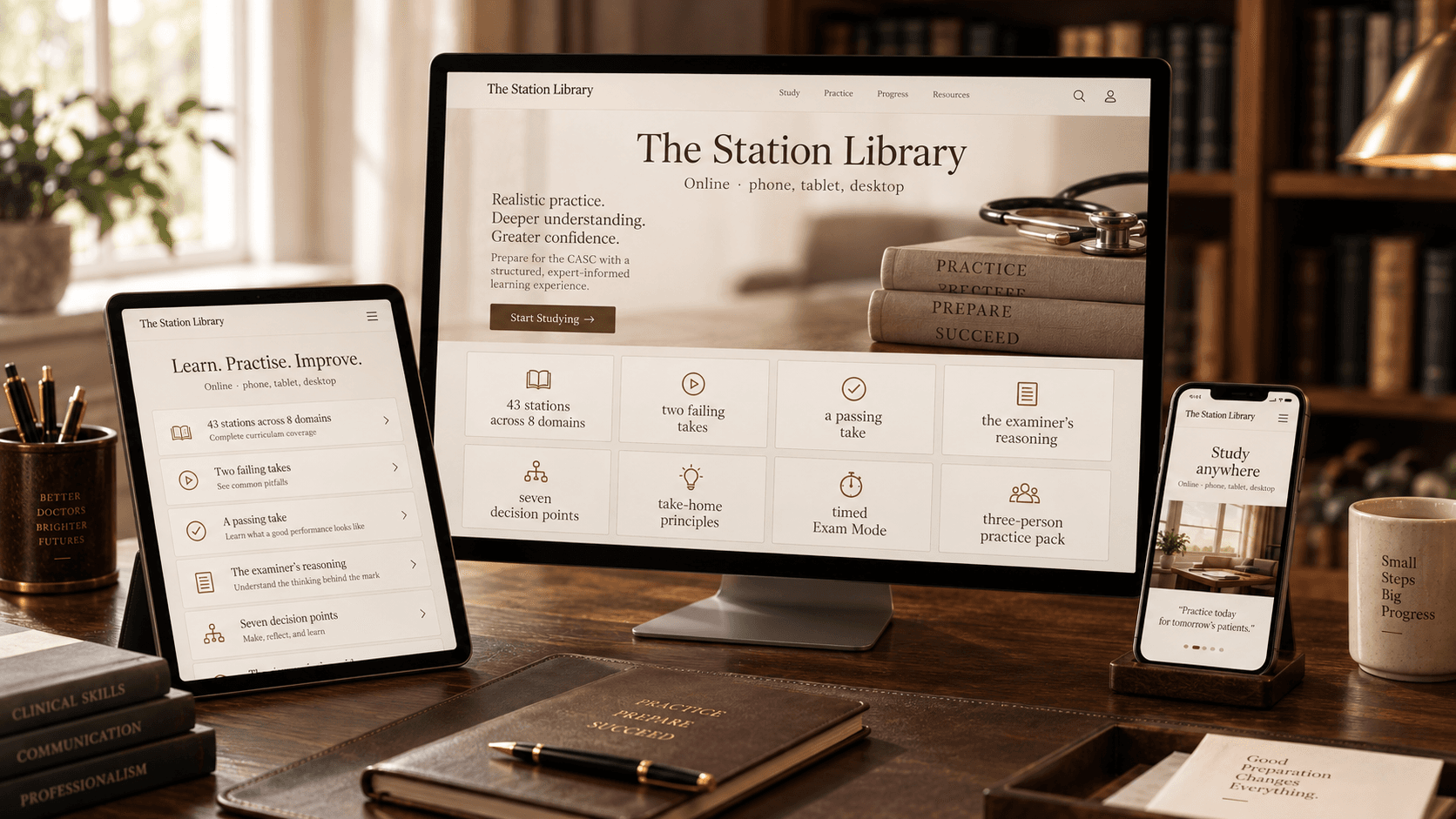
43 stations across 8 domains, each with two failing takes, a passing take, the examiner's reasoning, seven decision points, take-home principles, a timed Exam Mode and a three-person practice pack.
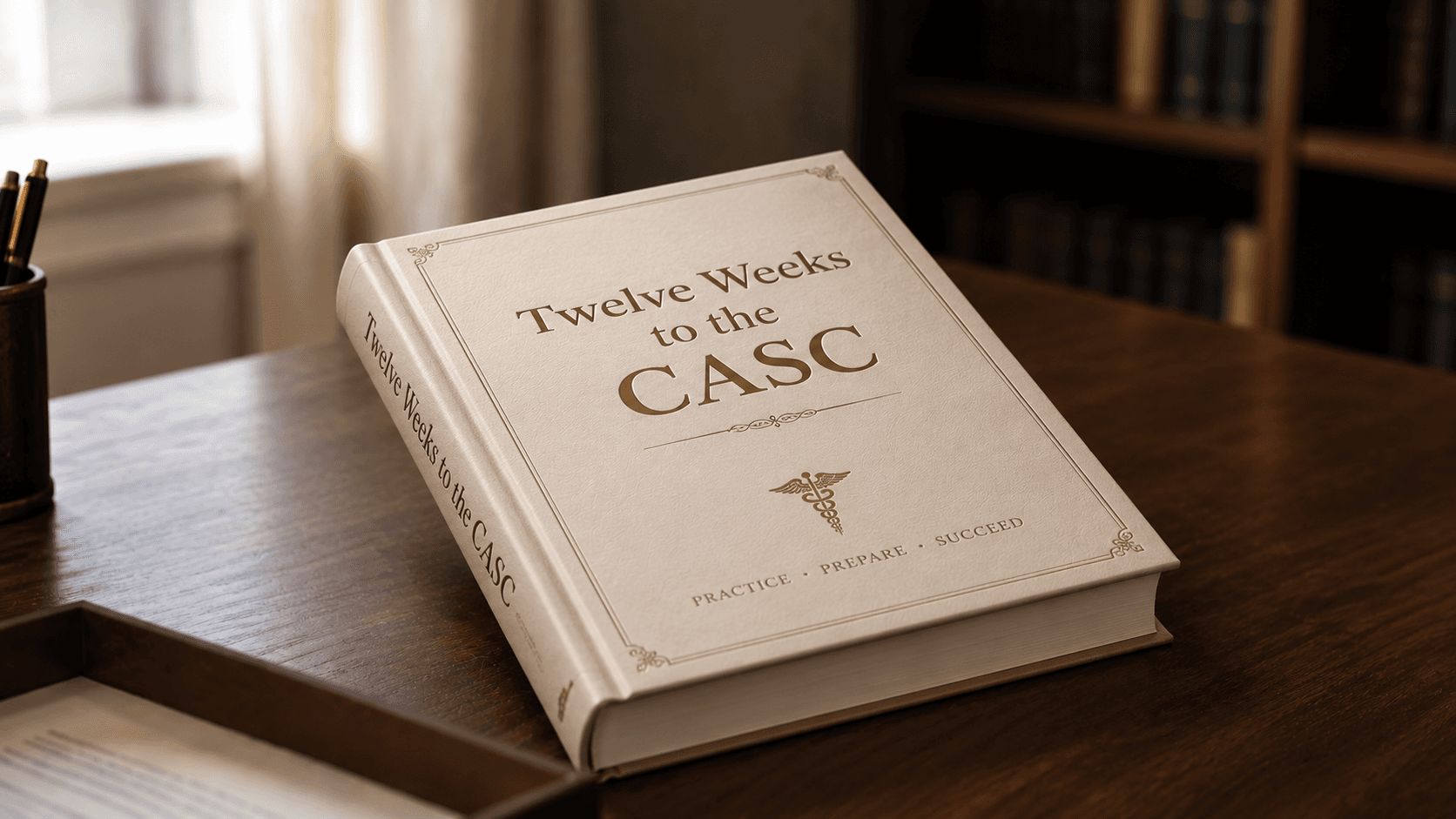
A planning workbook: four routes depending on the weeks you have, twelve weekly planner pages, a station log, a domain tracker, mock debrief sheets, the last fourteen days, and a chapter for candidates resitting.

It exists to solve the problem that actually stops people practising — not motivation, but finding two other people who are free on Tuesday evening. Find a trio, fix a time, swap the stations you found hardest.

Short notes from the examiner's side of the table, sent as you work through the library: one thing examiners see, one thing to practise this week, and the station it lives in.

Issued when you finish, recording the 43 stations and 8 domains you worked through.
Not lectures. Not model answers. Every station is built the same way, around the specific error that costs candidates the mark — then you make the decisions yourself. About 45 minutes in Learn Mode, then 7 minutes in Exam Mode.
What this station is really testing, and the two ways good candidates get it wrong.
The same consultation three times, line by line. One failure is obvious; the other is the kind one, and worse.
Tap any moment and read what an examiner is thinking as it happens — and why the mark is being lost or won.
You are in the chair. Choose, read the examiner's response, try again until you find the move that works.
Seven minutes, timed, on a patient you have not met. Then a three-person practice pack to run with colleagues that evening.
Station 7.2 is open to anyone, no login. Read it fail twice, read it pass, tap the examiner's reasoning, then make the seven decisions yourself.
 MEDLEX
Free guide
Where Medicine Meets Justice
MEDLEXFree tool
Where Medicine Meets Justice
The Examiner's Briefing — how the CASC is actually marked, the errors examiners see most, and the grammar of a British consultation. The Examiner's Error Log — a one-page self-audit you fill in after every practice station, so the person watching you can tick what they saw.
Both PDFs, immediately. Then occasional notes from the examiner's side of the table — unsubscribe in one click. No card, no commitment.

The library
Organised the way examiners think, each domain with its own hub and the stations that test it.

They have the textbooks. They have watched the videos. They can describe a risk assessment accurately at a desk, on their own, with no clock running.
Then they walk into a station where a woman is packing her bag to go home, and something she says at minute three changes what the station is actually about — and nothing they revised tells them what to do in the next four seconds.
The CASC is a performance examination. It tests what comes out of your mouth, under time, in front of someone who is marking you. Reading is the cheapest form of preparation to consume and the least likely to change your score.
“Would I be confident to have this candidate as my registrar? That is the question behind every mark — and the lens every station here is marked through.”
THE EXAMINER'S QUESTION
You are sitting the MRCPsych CASC, you have done the reading, and you know the gap is in performance rather than knowledge — or you are resitting and cannot afford to prepare the same way again.
The exam is not judged on what you know. It is judged on what the examiner watches you do with it.
Candidates sitting other psychiatry clinical examinations built on observed stations — the Arab Board and national board OSCEs among them. The marking language here is the CASC's; the skills underneath it — structure under time, the alliance before the assessment, the risk question that actually gets answered — are the foundations of psychiatric practice anywhere.
Anyone who wants model answers to memorise. This course will not give you scripts. It will show you why the scripts fail.
Enrol
The first hundred candidates pay £147. After that the price is £247. This is not a countdown timer: there are a hundred places at the founding price, and when they are gone, they are gone.
In exchange, I ask for one thing — a short piece of honest feedback once you have worked through it.
Most candidates do not need coaching. If you are not yet practising out loud every week, arrange that first — it is free and it will do more. Coaching is worth buying when a specific weakness has not moved despite regular practice, or after a failed attempt: sixty minutes online, performing stations and being marked the way an examiner marks.


The examiner
Consultant Forensic Psychiatrist · former CASC examiner
UK-trained Consultant Forensic Psychiatrist and Forensic Psychiatry Training Programme Director, with senior experience across clinical psychiatry, medico-legal practice, teaching and service leadership.
He has sat on the other side of the table. He knows where the mark is actually decided in each station — and it is rarely where candidates think. It is the four seconds after a patient says something unexpected. It is the risk question asked in a form that lets the patient say no. It is the capacity assessment that is fluent and general when it needed to be specific to one decision on one afternoon. It is the examination performed perfectly in silence on a man who was never told why.
These are the things that are easily missed and cost a great deal, and they are what this course is built around: not what to know, but what an examiner is watching for while you say it.
Station 7.2, complete and free, no login. Then 43 stations, the workbook, the practice group and 6 months' access for £147.